On our anniversary, Elisabeth gave me Pablo Neruda's Residence on Earth. I took it upon myself to read Henry Spain in Our Hearts, which is to me, the centrepiece of the whole book. It's a beautiful poem, don't get me wrong but for the first time I felt uncomfortable reading something to Henry. It was beyond the fact that for whatever reason he couldn't settle or get into the rhythm of the voice; it had to do with the horrible images of war, especially those of rivers of dead children's eyes floating in hell, gazing upon their killers face. Such is war, however and, as many have expressed, anyone who glamorizes it encourages the acts of war. This poem is a very harsh reminder about the reality of oppression, the resistance it will incur and the fate waiting for those who would put their greed above society's.
I'm more than happy to gently push my politics on my kid, without a context (In his brain), it felt weird reading him this. If he understood any of it, I'm sure he didn't get the joyous contrast, after all the horror and war, of the Solar Ode to the Army of the People and not the floating eyeballs.
It was also the first time that Henry hasn't connected with a piece of writing. Next up will be Rimbaud's Season in Hell with, hopefully, better results.
As and aside, I find it impossible to believe that Crass were not intimately with Neruda. The repetition of phrases and imagery, as well as pentameter of his verse suspiciously mirrors a lot of their music, especially their later work dealing with the Falkland Wars:
3.7.11
2.7.11
Counterpoint: Carle
Previously in this Blog That Never Gets Updated In Anyway That Makes Any Sense Whatsoever, I went on a bit of a tyrade that Elisabeth suggested may have scared some people off. Originally, this was going to be a semblance of an apologia but, since those people are now aparantly scared off, I shall continue my rant:
Eric Carle is inexorably tied to Ms. Boynton in my mind, not just because their books are so often mass gifted but because he's the anti-Boynton. Were I to ever complete my opus on Beatrix Potter, I would say that, in the world of Ms. Potter, he is the pictures, she is the words.
As I cannot remember all my points against Sandra Boynton and am too lazy to revisit them, I am going to use Eric Carle as a point-by-point refutation of Boynton in three acts, using only my dodgy memory and those books I've read as proof.
Act 1: The Very's:
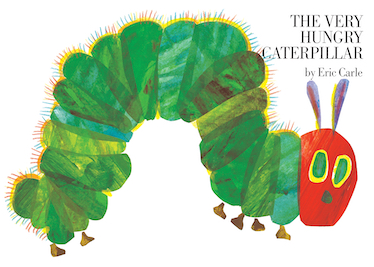
The Very Hungry Caterpillar was the first book I read to Henry. It's great because it's got one great big picture for little eyes to focus on with few enough words per page so those eyes don't get bored. There's a payoff at the end with a Very Colourful Butterfly to gaze upon. As Henry has gotten older, he's found the holes in the pages interesting to focus on.
There is an aural, visual, tactile sense going on with the three books in this trilogy. The Very Busy Spider has a web that the child can feel and encouraging Henry to touch the pages and literally feel the web getting built (As well as seeing it) adds to the story. The story itself is fairly repetitive but, unlike a certain author whose name rhymes with Sandra Boynton (oops), there is room to play around. For example, giving each animals who speaks to the spider a different voice. It helps that the pictures are big and bold and definite. They are obvious enough so that a young child knows what hey are, yet intricate enough to make you want to keep looking. They are a far cry from Boynton's stories which are basically made to amuse adults while reading to their child.
Finally, The Very Lonely Firefly works at an age stage higher than the first two. Here, the pictures are dimmer (in keeping with the story) and have a more complex breakdown as there are speech bubbles added. Also, the pictures are, in my opinion, scarier. This all makes sense in the context of a tale about a firefly lost in the night looking for his friends. I'm particularly partial to the ending and the Christmas light twinkling once (Spoiler!) the Very Lonely Firefly finds his friends. This last page baffled Henry for a while until one night he finally noticed the firefly's were twinkling and he looked at me, did a triple-take and literally said, I kid you not, "My God, It's full of stars."
What I am poorly articulating is that in these three books, there is a story, art and a moral (Eat right; work hard; don't worry you'll fit in) that is good for kids, re-readable (Hundreds of times) for adults and, above all, interesting. The story never gets in the way of the art and there is a parental freedom to interpret how you will.
Act 2: The What Do you Sees?
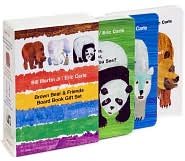
Technically these are not by Eric Carle, he just provided the art. That said, I believe that somewhere I addressed how Ms. Boynton could have been better served by better writing. Here, Eric Carle lends his art to an excellent series of books. The story is straight-forward & repetitive for the kid, the pictures are big & bold, there's a sense that something's going on but you're not quite sure what that something is.
Henry genuinely seems to like these as I'm sure in his world he's hearing & seeing mumble, mumble, PICTURE! And as the series progresses and the pictures become increasingly detailed, there is more for him to look at. Honestly, this is what Sandra Boynton should have done a long time, focusing her art on someone else's stories.
(Of course she would then have to do things like draw in detail, make things bold & appealing to children, not the weird adultopods she imagines that the all are, but I digress...)
Act 3: The My Very Firsts:
Henry's not gotten into these yet and, while I have the Very First Book of Words, Shapes, Food & Animal Homes, I also appear to be missing several others including, numbers, colours, motion, animal sounds and bowel movements. The four I have i got on sale and, while Henry's not old enough to be able to figure them out, they serve two great purposes.
The first is that they're split down the middle which mean that if you're a baby like Henry, there's double the pages to turn! Carle's bold colours and artwork continue to draw his attention offer him something to do with the book as well as some enjoyment.
The second is that the bold colours and artwork continue to draw his attention offer him something to do with the book as well as some enjoyment. Crap. That's the first one. I'll come up with points two and maybe even a third once Henry's at the stage where he is able to figure out that a doggie live in a doghouse (The animal homes book is hard. I've not been able to figure them all out)
The point is that Eric Carle, as opposed to other writers, seems to 'get' kids. And parents. When I finish reading Henry one of his books I don't feel like I've made him a target for bullying.
20.6.11
Sandra Boynton Makes Me Hate Babies
Or, as Elisabeth would have me write, Sandra Boynton Makes Me Hate Parents.
Caveat 1: I admit that sometimes I have no taste. Case in point, I hate The Big Lebowski. I find it stupid, unfunny and basically pointless. I hear other people think it's great. They're wrong, of course, but that's their opinion.
Caveat 2: I'm about to criticize a bunch of gifts. No offence is meant to the gift-givers, I know that this was done in good faith. I want you to know that your gift was a) appreciated for the gesture and b) appreciated for the rant it provided me. To be honest, I don't much remember who has given us what.
So, with that in mind, I come to Sandra Boynton. An author I'd never heard of a few months ago and whose name I now curse. And not just me, Henry recoils like an adder when he sees a cover of one of her books. I've brought his reaction up with the owner of the local book store for kids who has told me he's too young to get it and will grow into them, but I feel that the way the aging process works, where a person becomes smarter over time (Until thirty and then you become your parents), this runs counter intuitive to logic and if indeed these books are for older kids, then why are they so stupidly, utterly dumb and offensive?
In all fairness, I'm sure there are stupider things. Like toy poodles, Juggalo's and de-alcoholized beer. But these aren't marketed to sensitive, developing brains. People who buy toy poodles are already functionally retarded. This is the kind of banal humour for people who thought Family Matters was piss-your-pants funny and who can help but go "Aww," whenever a toddler vomits out its catch phrase in Steve Guttenberg's latest attempt at prime-time relevance.
I thank you all who gave us these books as gifts but they are atrocious and poor old Henry hates them. The literally make him cry. They are also horribly morally suspect. Case in point:
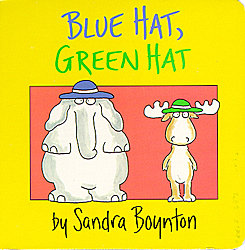
Blue Hat, Green Hat. In which a retarded turkey in unable to dress itself properly. It puts on clothes in inappropriate ways and is last seen dressed in too many layers, diving into a swimming pool to presumably drown while all the other better dressed animals who know how to put their clothes on properly, watch on in empty stoned silence.
Throughout this book, the animals gaze into nothingness, do not attempt to help the unfortunate who has crossed their paths and through their passivity let him die.
The Turkey is portrayed as a species (As opposed to the elephant, moose or small cute furry whatever) to be imbecilic, lemming-like and disposable.
But Not The Hippopotamus is another exercise in exclusion as it tells the tale of animals having fun with each other while either ignoring or being blatantly racist to the titular hippopotamus. Page after page it stares at animals doing fun things until finally they invite him to join them.
The punchline is that as soon as the hippopotamus is allowed into the circle, an armadillo it excluded from it. Any opportunity to turn this book into a message of inclusivity or to contextualize why it's not okay to ostracize someone is lost for a cheap joke that actually makes light of shyness/exclusion/ favouritism/ racism. I don't want to go so far as to say the book actually encourages racism but Ms. Boynton has, according to Wikipedia, written more than forty book and four thousand fucking greeting cards. It's not like she's new at this or learning the ropes or this is her difficult second novel, she's literally produced thousands of works. She either thinks racism is funny or she is the stupidest children's writer since Chuck VonNasty wrote It's Okay to Poke Your Eye Out, It'll Grow Back in Time For Supper Now Smile and Eat Your Plate of Broken Glass.
But I digress...
Horns To Toes And In Between is about three inbred uncles who are also monsters. They sing about the parts of their bodies, tickle each other and then dance around, celebrating their morbid obesity.
This is a lazy book with a lazy story and lazy pictures. It commits the cardinal sin of children's books in being utterly forgettable. I honestly didn't know we had it for at least a month.
It also features Ms. Boynton's most irritating flourish: The weird circular belly button. I don't know if it's meant to be cute but it draws unnecessary attention to her creatures nether-regions as well as looks like a sadistic cork lodged in the bellies of all her cute kiddy animals; ready to pop at any moment and spill out their guts until the inbred uncles of Horns to Toes are little more that carpets of a middle-class couples basement.
Belly Button Book! (Yes, that's the title. No "the" and the exclamation point is thrust in there, forcing you to think this is a fun and/or exciting literary trip you're about to embark upon) feels like an aggressive attempt to make your kid cute by calling it's belly button "bee bo." This is the kind of humour for stunted adults who think that Saturday's Hi and Lois strip is Bill Hicks level cutting-edge satire.
This is a book geared for older kids (You know this because it's slightly larger than all her other books) to force them to act like younger kids.
Here, the hippopotamus (No longer an ostracized freak) acts like a freak that I'd like to ostracize by devoting its time to loving their so-called bee bo's and going to bee bo positive beaches where they sing songs about their bee bo. There is a level of forced saccharine jokey wholesomeness that is thrust down your throat throughout this book that I'm left feeling hostile towards Ms. Boynton. The book itself is pointless. It's just an attempt to push a catch-phrase that is neither witty or clever or makes any sense at all.
Opposites was one of the, if not the, first books that Henry received and I had high hopes for it. Just page after page of opposite stuff. You know, hot/ cold. On/ off. Anterior/ posterior. With corresponding pictures. The thing that makes this book go from good idea to bad (See what I did there?) is that the words and pictures are such a jumble that it's hard for a kid to know what is going on.
It's here that I might think that the lady in the bookstore had a point. Maybe Ms. Boynton's books are indeed for kids a mite older then Henry. But if this is so then why is she writing about such simple notions? Why is she making dumbed down books for dumbed down kids (Who's parents see nothing wrong with a quaint touch of racism)? It literally baffles me.
The final book I need to address is The Going To Bed Book. Just to show I'm not a spiteful jerk, I will admit when I enjoy something. Even The Big Lebowski made me laugh. Twice.
This book worked for a while. Henry enjoyed it and we enjoyed reading it to him. The thing is, unlike Sandra Boynton's other books, this book is a poem with pictures and the thing that he clues in on is the cadence and rhythm of the voice reading to him. He's too young to grasp the pictures (Hell, he's too young to grasp anything) but he's able to bounce along with the voice saying stuff. This is absent in all Susan Boynton's other books (That we own) and were they there, then perhaps Henry would like them as well.
Personally, I don't care for her artistic style (Though literally millions would disagree) but it's irritating that she doesn't ever vary it to reflect the age range that she's writing for. If the words, pictures and layouts changed for a child's capacity to understand, I might feel very differently. But they're not. They're too complicated for young kids and too simple for older ones. They feel like they've been written by someone who's never had, raised or met children but has a kind of vague understanding of what children are and has geared a career towards that misunderstanding.
Caveat 1: I admit that sometimes I have no taste. Case in point, I hate The Big Lebowski. I find it stupid, unfunny and basically pointless. I hear other people think it's great. They're wrong, of course, but that's their opinion.
Caveat 2: I'm about to criticize a bunch of gifts. No offence is meant to the gift-givers, I know that this was done in good faith. I want you to know that your gift was a) appreciated for the gesture and b) appreciated for the rant it provided me. To be honest, I don't much remember who has given us what.
So, with that in mind, I come to Sandra Boynton. An author I'd never heard of a few months ago and whose name I now curse. And not just me, Henry recoils like an adder when he sees a cover of one of her books. I've brought his reaction up with the owner of the local book store for kids who has told me he's too young to get it and will grow into them, but I feel that the way the aging process works, where a person becomes smarter over time (Until thirty and then you become your parents), this runs counter intuitive to logic and if indeed these books are for older kids, then why are they so stupidly, utterly dumb and offensive?
In all fairness, I'm sure there are stupider things. Like toy poodles, Juggalo's and de-alcoholized beer. But these aren't marketed to sensitive, developing brains. People who buy toy poodles are already functionally retarded. This is the kind of banal humour for people who thought Family Matters was piss-your-pants funny and who can help but go "Aww," whenever a toddler vomits out its catch phrase in Steve Guttenberg's latest attempt at prime-time relevance.
I thank you all who gave us these books as gifts but they are atrocious and poor old Henry hates them. The literally make him cry. They are also horribly morally suspect. Case in point:
Blue Hat, Green Hat. In which a retarded turkey in unable to dress itself properly. It puts on clothes in inappropriate ways and is last seen dressed in too many layers, diving into a swimming pool to presumably drown while all the other better dressed animals who know how to put their clothes on properly, watch on in empty stoned silence.
Throughout this book, the animals gaze into nothingness, do not attempt to help the unfortunate who has crossed their paths and through their passivity let him die.
The Turkey is portrayed as a species (As opposed to the elephant, moose or small cute furry whatever) to be imbecilic, lemming-like and disposable.
But Not The Hippopotamus is another exercise in exclusion as it tells the tale of animals having fun with each other while either ignoring or being blatantly racist to the titular hippopotamus. Page after page it stares at animals doing fun things until finally they invite him to join them.
The punchline is that as soon as the hippopotamus is allowed into the circle, an armadillo it excluded from it. Any opportunity to turn this book into a message of inclusivity or to contextualize why it's not okay to ostracize someone is lost for a cheap joke that actually makes light of shyness/exclusion/ favouritism/ racism. I don't want to go so far as to say the book actually encourages racism but Ms. Boynton has, according to Wikipedia, written more than forty book and four thousand fucking greeting cards. It's not like she's new at this or learning the ropes or this is her difficult second novel, she's literally produced thousands of works. She either thinks racism is funny or she is the stupidest children's writer since Chuck VonNasty wrote It's Okay to Poke Your Eye Out, It'll Grow Back in Time For Supper Now Smile and Eat Your Plate of Broken Glass.
But I digress...
Horns To Toes And In Between is about three inbred uncles who are also monsters. They sing about the parts of their bodies, tickle each other and then dance around, celebrating their morbid obesity.
This is a lazy book with a lazy story and lazy pictures. It commits the cardinal sin of children's books in being utterly forgettable. I honestly didn't know we had it for at least a month.
It also features Ms. Boynton's most irritating flourish: The weird circular belly button. I don't know if it's meant to be cute but it draws unnecessary attention to her creatures nether-regions as well as looks like a sadistic cork lodged in the bellies of all her cute kiddy animals; ready to pop at any moment and spill out their guts until the inbred uncles of Horns to Toes are little more that carpets of a middle-class couples basement.
Belly Button Book! (Yes, that's the title. No "the" and the exclamation point is thrust in there, forcing you to think this is a fun and/or exciting literary trip you're about to embark upon) feels like an aggressive attempt to make your kid cute by calling it's belly button "bee bo." This is the kind of humour for stunted adults who think that Saturday's Hi and Lois strip is Bill Hicks level cutting-edge satire.
This is a book geared for older kids (You know this because it's slightly larger than all her other books) to force them to act like younger kids.
Here, the hippopotamus (No longer an ostracized freak) acts like a freak that I'd like to ostracize by devoting its time to loving their so-called bee bo's and going to bee bo positive beaches where they sing songs about their bee bo. There is a level of forced saccharine jokey wholesomeness that is thrust down your throat throughout this book that I'm left feeling hostile towards Ms. Boynton. The book itself is pointless. It's just an attempt to push a catch-phrase that is neither witty or clever or makes any sense at all.
Opposites was one of the, if not the, first books that Henry received and I had high hopes for it. Just page after page of opposite stuff. You know, hot/ cold. On/ off. Anterior/ posterior. With corresponding pictures. The thing that makes this book go from good idea to bad (See what I did there?) is that the words and pictures are such a jumble that it's hard for a kid to know what is going on.
It's here that I might think that the lady in the bookstore had a point. Maybe Ms. Boynton's books are indeed for kids a mite older then Henry. But if this is so then why is she writing about such simple notions? Why is she making dumbed down books for dumbed down kids (Who's parents see nothing wrong with a quaint touch of racism)? It literally baffles me.
The final book I need to address is The Going To Bed Book. Just to show I'm not a spiteful jerk, I will admit when I enjoy something. Even The Big Lebowski made me laugh. Twice.
This book worked for a while. Henry enjoyed it and we enjoyed reading it to him. The thing is, unlike Sandra Boynton's other books, this book is a poem with pictures and the thing that he clues in on is the cadence and rhythm of the voice reading to him. He's too young to grasp the pictures (Hell, he's too young to grasp anything) but he's able to bounce along with the voice saying stuff. This is absent in all Susan Boynton's other books (That we own) and were they there, then perhaps Henry would like them as well.
Personally, I don't care for her artistic style (Though literally millions would disagree) but it's irritating that she doesn't ever vary it to reflect the age range that she's writing for. If the words, pictures and layouts changed for a child's capacity to understand, I might feel very differently. But they're not. They're too complicated for young kids and too simple for older ones. They feel like they've been written by someone who's never had, raised or met children but has a kind of vague understanding of what children are and has geared a career towards that misunderstanding.

16.6.11
Stats
I love checking this blog's stats. More specifically the search keywords that bring people here. The following, for gratuitous blogging purposes only, are some of my most interesting ones:
- magical carrot Henry (?)
- hobo with a shotgun arm stump (???)
- Falcor dies (?!?!)
- Godzilla ejaculated (!!!)
- Ezzo estrangement - 4 hits
- Ezzo estranged daughters why - 3 hits
- and a series of permutations of the above on a nearly weekly basis
Who'da known?
13.6.11
In Summary
I'm coming off a fairly successful weekend where I was able to take Henry to his first petting zoo and where we all went on a long trip to the beach yesterday which for the first time, he seems to have really engaged with, playing on swings and waving at pretty much anybody, so I figure that I should re-engage with the blog a little bit. It also helps that the work on my office is finally finished and the most expensive room in the house is devoted to video games and aurally offensive music.
My analysis of the works or Beatrix Potter is still on hold. Reading her books to him as he falls asleep continues to be a challenge due to a combination of the sparseness of her writing as well as a lack of rhythm while reading out loud. Henry has had several colds and flus so I decided that since he was spending so much time in bed, I should start reading him something with a little more substance which lead me to The Thief of Always by Clive Barker.
I got this book during my Stephen King/ Clive Barker phase and remember being disappointed that it was a book for children. I'd been hoping for the standard scary/ freaky/ violent fare I was gobbling up at the time. I also devoured the book very quickly and loved it.
Reading this with new eyes, I was surprised to find so much going on in it. The entire first act serves as a warning to children about how easy it is to fall into the hand of a stranger and be seduced my false promises away from your parents.
The second act traces the shift from the fantasy of how life would be without rules to the horror of discovering you've been kidnapped and cannot escape to return to your old life. It ends quite darkly where the young protagonist gets to experience the horror his family has has to go through in losing a child.
Of course, this is a kids book so it is in the third act that the young man decides to regain control of his life and make amends, you get the sense that things are going to turn out alright however, as Mr. Barker has already gone down a rather dark route earlier, there is the niggling question as to just how happy the ending is going to be.
This is definitely a book for ten year olds (This point is reenforced several times throughout the story as well as on the flap) and can be quite scary if you're so inclined. The illustrations by Clive Barker add to the overall creepiness (e.g., fat naked lady melting with her eyeballs dangling from their stalks obscuring her breasts). But with the books theme of illusions and the constant reminder that much of what is happening is not real, it should be a good kind of scary. The final act is also dedicated to the concept of overcoming you fears so there is a nice little catharsis there as well.
Hollywood has been dithering about making this a movie for years and I find it a pity this has not come to pass. It's also made me curious about Clive Barker's Abarat series of children's books and, should Henry have any interest in The Thief of Always when he's older, will certainly consider picking these up for him as well.
Next up, I read Henry The Little Prince. To this day I'm still frustrated that the book really has nothing to do with this:
Which is a shame because then I would like the it. This was my first time reading it to the end, nt in spite of doing at least two book reports on it in my school days. Both times I reached the same point and never finished reading the book (Granted, i was reading it in French) and wrote the book report based on my knowledge of the first thirty or so pages and the cartoon. It's an interesting reflection of the school system that on both reports I got a fairly good grade, considering that I was a million miles off with regard to what happens in the rest of the book. Namely that at the end, The little Prince does not go off into space and have further adventures; he gets bitten by a snake and dies.
I suppose a case could be made using the Life of Pi Defence that the book is open ended and you can decide that The Little Prince flies through space through the power of death but I find this is a stretch of the imagination even for a book that gets away with the idea that there is a 20' diameter plant upon which lives a drunk with a never-ending supply of alcohol. Really, M. de Saint-Exupery, you paint such a wonderful picture of Heaven.
Any cynicism I have for the book is primarily due to an awareness that there is something going on, some kind of message in all The Little Princes adventures, that is entirely lost on me. Other that the religious ones. Those hit you over the head like you're in a whack-a-mole.
With that done, I have now moved on to reading Henry Treasure Island. We're only three chapters in and I doubt we'll get much farther. He's reached a stage where we need to retrain him to fall asleep on his own and if we're not doing that, he's so zonked out by the time we put him to bed that there's no point reading to him. Which is unfortunate because I was pleasantly surprised by the first three chapters. It was not the dry, dated kind of story I was expecting and trucked along nicely with lots of pirate-speak. I'll keep at it for now for my own entertainment and should Henry go through a pirate phase, I imagine this will sate his interest nicely.
As for me, I've just wrapped up ShadowMarch by Tad Williams. I don't want to turn this into a Game of Thrones rant but in relation to my thoughts on this book, but it feels inevitable.
This is the third novel of a four part series originally conceived to be a television series. It was, however, never picked up. This is unfortunate because George R. R. Martin wrote A Song of Fire and Ice after reading tad William's first fantasy series, Memory, Sorrow and Thorn and realizing that you can write epic fantasy while exploring adult themes in mature ways.
It frustrates me that HBO has picked up a still unfinished fantasy series in which the author take five-plus years to finish a novel, while Tad Williams is a known quantity who, at the very least, has established that he can finish an epic and tie together all the lose ends.
As it stands, the Shadowmarch series is on track to better Memory, Sorrow and Thorn. This being the third book in what is essentially one very long novel, he continues to pick up immediately where the last one ended and entirely lack an ending or resolution of any single plot point. It's infuriating yet I love that the book just stops and you have to wait for the next one but, if you're going to write a single massive story, i think this is the way to do it, rather than to shoehorn in needless plot developments which do not serve the plot just to give your readers some satisfaction. I can think of no greater cliffhanger that to have the story simply stop and have to wait a year to pick up where you left off.
Next time: A gratuitous attempt to post more than one entry in the month of June.
15.5.11
The Tale of Three Bad Parents
Part 8: The Tale of Tom Kitten:
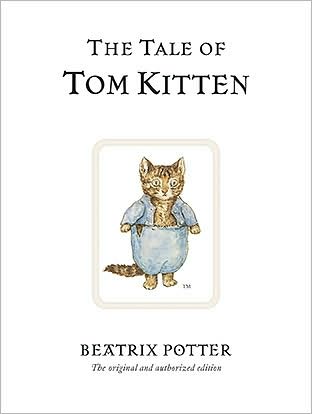
True confession time: I always thought that the story of Tom Kitten was that he over ate and bursts out of his clothes. (In all fairness, Tom Kitten is described as very fat but he's never portrayed as gluttonous or lazy.)
What its lazy is his mother who is more concerned about putting on a good tea when company comes 'round. In preparation for said company, she gets her kids ready in their good clothes and leaves them to play outside unsupervised so she can get something to eat.
Kids being kids, they play and Tom Kitten, being dressed inappropriately by his mother, loses his clothes.
Then along comes the frankly, rather creepy, adult Puddle-Ducks who, instead of being helpful, tease the kittens, dress up in and then steal Tom Kitten's clothes, leaving him naked. Weird.
So the kids go home and, naturally, their mother takes no responsibility in her poor choices (A common trait of abusive parenting) and punishes her kids instead of losing face in front of her friends and be able to keep up the appearance that they are a healthy, functioning family. The kids act up again and the story ends in an unsatisfying way with the promise of more books about the antics of the kittens.
The interesting thing about this book is the coda at the end where the creepy Puddle-Ducks lose the stolen clothes in the pond and Beatrix Potter attempts a little mythology creation, explaining that the Puddle-Ducks are still looking for them and that's why ducks bob their head under water.
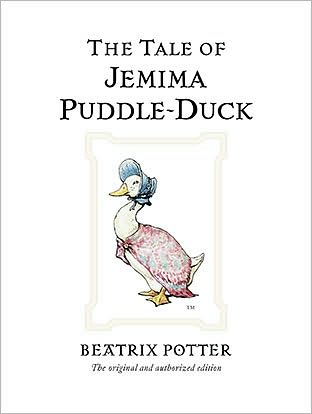
Part 9: The Tale of Jemima Puddle-Duck
Jemima Puddle-Duck is quite possible the most clueless and unlikeable 'hero' that I've ever encountered in a book. Her outright stupidity is jaw dropping when you consider her dedication to bring and presumably raise a bunch of children all on her own.
So basically, Jemima really wants to have kids but she's got nowhere to lay her eggs. One day she comes across fox who is a moustache-twirling caricature of a villain. Jemima not only fails to grasp that this is a villain she is interacting with, she fails to grasp the he's not just a fox but an animal, assuming instead that he's a friendly gentleman.
With the 'gentleman's' help, Jemima is shown a great place to build her nest: In a shed filled with feathers. This would be like being pregnant and invited over to someones house for a meal and discovering that their dining room is decorated with human hair and skin. Jemima thinks it's a great place to lay her eggs.
So she lays them and the 'gentleman' suggests that she should bring some ingredients to make a large feast before the dull process of incubating the eggs begins. He suggests he will make her a tasty omelet if she gathers the correct ingredients for it. So just to contextualize this: You're pregnant and sitting in the strangers dining room which is decorated with hair and skin and he tells you he's going to serve up fetus stew. If you were Jemima Puddle-Duck you'd say "Yum yum! I'll help you cook it."
(In all fairness page thirty-nine contains what must be one of literature's most understated sentences: "Jemima Puddle-Duck was a simpleton.")
During the process of gathering the ingredients, she mentions to a dog what's going on and he, possessing the keen intelligence of a dog, realizes something's up and gathers some buddies.
As the action comes to a head, the fox gets nasty and impatient towards Jemima and, while she checks in on her eggs, the dog posse shows up, chases off the fox and, in an orgy of bloodlust, eats all of Jemima's eggs.
Jemima's escorted back to the farm where she has learned nothing, lays more and only four of the chicks survive. And they all live happily ever after.
Part 10: The Tale of the Flopsy Bunnies

Benjamin Bunny is all grown up, married his cousin and has had so many children that they are devoid of individual personalities and the couple has to sponge off the work and generosity of their family members in order to get by.
When they're not able to mooch off Peter Rabbit (Who appears to have gotten over his PTSD, become a farmer and married a fat little thing in a pink frock), Benjamin bunny takes his family out to the dump to eat garbage. Specifically, fermented cabbage which, apparently, has 'soporific' effects.
So after he takes his family out and they all get high after eating garbage, they all pass out and/or laze about in a drugged out stupor. Benjamin puts a paper bag on his head and has a chat with a mouse, not noticing that the farmer has come along, found his children and popped them in a burlap sack with the intention of skinning them and cutting off their heads and turning them into food and clothes.
Luckily his cousin-wife has not taken part in the orgy of drug-taking and comes along, realizes something is wrong and with the help of the mouse, saves her children, replacing them in the sack with vegetables.
They follow the farmer, who seems rather inbred himself, to his home where they hear about what his intentions were with the bunnies and their skins. Then for no reason the youngest bunny is badly hurt by a flying gourd and they go home without learning any lessons.
The helpful mouse is rewarded that Christmas with some rabbit fur outfits. So I suppose the littlest bunny ended up expiring from his injuries and his parents were thoughtful enough to turn their dead baby into clothes. The end.
True confession time: I always thought that the story of Tom Kitten was that he over ate and bursts out of his clothes. (In all fairness, Tom Kitten is described as very fat but he's never portrayed as gluttonous or lazy.)
What its lazy is his mother who is more concerned about putting on a good tea when company comes 'round. In preparation for said company, she gets her kids ready in their good clothes and leaves them to play outside unsupervised so she can get something to eat.
Kids being kids, they play and Tom Kitten, being dressed inappropriately by his mother, loses his clothes.
Then along comes the frankly, rather creepy, adult Puddle-Ducks who, instead of being helpful, tease the kittens, dress up in and then steal Tom Kitten's clothes, leaving him naked. Weird.
So the kids go home and, naturally, their mother takes no responsibility in her poor choices (A common trait of abusive parenting) and punishes her kids instead of losing face in front of her friends and be able to keep up the appearance that they are a healthy, functioning family. The kids act up again and the story ends in an unsatisfying way with the promise of more books about the antics of the kittens.
The interesting thing about this book is the coda at the end where the creepy Puddle-Ducks lose the stolen clothes in the pond and Beatrix Potter attempts a little mythology creation, explaining that the Puddle-Ducks are still looking for them and that's why ducks bob their head under water.
Part 9: The Tale of Jemima Puddle-Duck
Jemima Puddle-Duck is quite possible the most clueless and unlikeable 'hero' that I've ever encountered in a book. Her outright stupidity is jaw dropping when you consider her dedication to bring and presumably raise a bunch of children all on her own.
So basically, Jemima really wants to have kids but she's got nowhere to lay her eggs. One day she comes across fox who is a moustache-twirling caricature of a villain. Jemima not only fails to grasp that this is a villain she is interacting with, she fails to grasp the he's not just a fox but an animal, assuming instead that he's a friendly gentleman.
With the 'gentleman's' help, Jemima is shown a great place to build her nest: In a shed filled with feathers. This would be like being pregnant and invited over to someones house for a meal and discovering that their dining room is decorated with human hair and skin. Jemima thinks it's a great place to lay her eggs.
So she lays them and the 'gentleman' suggests that she should bring some ingredients to make a large feast before the dull process of incubating the eggs begins. He suggests he will make her a tasty omelet if she gathers the correct ingredients for it. So just to contextualize this: You're pregnant and sitting in the strangers dining room which is decorated with hair and skin and he tells you he's going to serve up fetus stew. If you were Jemima Puddle-Duck you'd say "Yum yum! I'll help you cook it."
(In all fairness page thirty-nine contains what must be one of literature's most understated sentences: "Jemima Puddle-Duck was a simpleton.")
During the process of gathering the ingredients, she mentions to a dog what's going on and he, possessing the keen intelligence of a dog, realizes something's up and gathers some buddies.
As the action comes to a head, the fox gets nasty and impatient towards Jemima and, while she checks in on her eggs, the dog posse shows up, chases off the fox and, in an orgy of bloodlust, eats all of Jemima's eggs.
Jemima's escorted back to the farm where she has learned nothing, lays more and only four of the chicks survive. And they all live happily ever after.
Part 10: The Tale of the Flopsy Bunnies
Benjamin Bunny is all grown up, married his cousin and has had so many children that they are devoid of individual personalities and the couple has to sponge off the work and generosity of their family members in order to get by.
When they're not able to mooch off Peter Rabbit (Who appears to have gotten over his PTSD, become a farmer and married a fat little thing in a pink frock), Benjamin bunny takes his family out to the dump to eat garbage. Specifically, fermented cabbage which, apparently, has 'soporific' effects.
So after he takes his family out and they all get high after eating garbage, they all pass out and/or laze about in a drugged out stupor. Benjamin puts a paper bag on his head and has a chat with a mouse, not noticing that the farmer has come along, found his children and popped them in a burlap sack with the intention of skinning them and cutting off their heads and turning them into food and clothes.
Luckily his cousin-wife has not taken part in the orgy of drug-taking and comes along, realizes something is wrong and with the help of the mouse, saves her children, replacing them in the sack with vegetables.
They follow the farmer, who seems rather inbred himself, to his home where they hear about what his intentions were with the bunnies and their skins. Then for no reason the youngest bunny is badly hurt by a flying gourd and they go home without learning any lessons.
The helpful mouse is rewarded that Christmas with some rabbit fur outfits. So I suppose the littlest bunny ended up expiring from his injuries and his parents were thoughtful enough to turn their dead baby into clothes. The end.
Subscribe to:
Posts (Atom)